
Last updated: October 12, 2026
Key Takeaways
- We reviewed Bing’s guidance, the sitemaps protocol, and Microsoft’s documentation on Bingbot URL discovery and XML sitemap handling.
- HTML sitemaps can help Bing find URLs because they are crawlable link pages, not because they have special indexing power.
- Both formats can surface hard-to-reach URLs, but both should point to indexable, canonical pages rather than duplicates.
- For indexing first, XML is the stronger choice unless the site is tiny and the main need is navigation rather than crawl submission.
FTC disclosure: this article contains no affiliate links.
Quick Answer: For indexing, Bing XML sitemap is the stronger option because it is built for crawler discovery and URL submission; HTML sitemap still helps with navigation and can support discovery, but it is not the better indexing tool. Bing’s sitemap guidance and the sitemaps protocol support that view [Bing Webmaster Guidelines; sitemaps.org].
In short: Bing XML sitemap is the one to prioritize for indexing, because it is built for crawler discovery and URL submission; HTML sitemap is still useful for internal navigation and can help Bing find deep URLs, but it is not the stronger indexing tool.
We based this comparison on Bing Webmaster Guidelines, sitemaps.org, and standard SEO practice around crawl discovery and internal linking, not on product claims or personal testing. Bing has said XML sitemaps help it discover URLs, and sitemaps.org defines the XML format for crawlers [Bing Webmaster Guidelines; sitemaps.org]. First published 12 October 2026.
How we compared
So, we read the published guidance from Bing, the sitemaps protocol, and the parts of Microsoft’s documentation that explain how Bingbot discovers URLs, processes XML sitemaps, and uses internal links. Then we compared the two sitemap types on the factors that actually change indexing outcomes: crawl discovery, coverage of deep URLs, maintenance burden, and how much each format tells Bing versus a human visitor. No product shortlist fits here; just two sitemap formats and the evidence around how they work.
Verdict
Bing XML sitemap wins for indexing, because it gives Bing a direct, machine-readable list of URLs and metadata. When the site is tiny and the real problem is helping users move through a large site with weak internal navigation, that’s the one I’d pick.
Quick spec table
| Factor | Bing XML sitemap | HTML sitemap |
|---|---|---|
| Main purpose | Machine-readable URL discovery for crawlers | Human-readable site navigation |
| Best indexing use | Faster discovery of important or deep URLs | Backup discovery path for orphaned or buried URLs |
| Metadata support | Yes: lastmod, changefreq, priority fields in the XML standard | No standard metadata fields for crawlers |
| Maintenance | Must stay current as URLs change | Must stay current, but is usually simpler to read and audit |
| Best fit | Large, dynamic, or deep sites | Smaller sites or sites with weak navigation |
| Indexing impact | Direct and usually stronger | Indirect and usually weaker |
Where they differ
Crawl discovery
Bing XML sitemap wins this round, because Bing’s own guidance treats submitted XML sitemaps as a direct discovery signal and the protocol is designed to list canonical URLs in a format crawlers can parse quickly [Bing Webmaster Guidelines; sitemaps.org].
HTML sitemap can still help Bing find URLs, but only because it is a normal page full of links, not because it has special indexing power. A crawler can follow those links, yet that is slower and less precise than an XML list that says, “these are the URLs I want you to know about.” That’s the whole trick.
Metadata and freshness
Bing XML sitemap wins again, because the XML standard allows fields such as <lastmod>, and Bing documents sitemap submission and crawl guidance around that structured input [sitemaps.org; Bing Webmaster Guidelines].
That matters for indexing because changed URLs can be surfaced more cleanly than they can through an HTML directory page. HTML sitemap pages usually show links only, so Bing has to infer importance and recency from the page itself and the pages it points to. In practice, that guesswork can get muddy fast.
Human usability
By contrast, HTML sitemap wins this round, because it is built for people who need a plain list of site sections and URLs. If a user is lost in a large catalog or a legacy site, an HTML sitemap can act like a map of the whole structure instead of a crawler feed.
That user benefit can help indexing indirectly. If visitors and editors use the page to reach buried URLs, those URLs may gather more internal links and become easier for Bingbot to reach. The lift is real, but it is second-order.
Maintenance burden
XML sitemap usually wins on control, while HTML sitemap wins on simplicity for small sites. An XML file can be generated automatically by a CMS or plugin, which keeps the list closer to the live URL set. An HTML sitemap page is easy to read and edit by hand, but that same manual feel becomes a drawback on larger sites with frequent URL changes.
For indexing, the failure mode matters more than the convenience. A stale XML sitemap is bad; a stale HTML sitemap is also bad, but it is easier for search engines to ignore because it has no special protocol value beyond the links it contains.
Scale
Bing XML sitemap wins for large or complex sites, because it is better suited to thousands of URLs, segmented sitemap files, and sitemaps index files [sitemaps.org].
HTML sitemap is the weaker option when the site is large enough that a human list becomes unwieldy. Once a page turns into a giant directory, the user experience degrades and the crawler signal becomes less focused. It gets crowded in a hurry.
Indexing confidence
XML sitemap wins because it tells Bing which URLs exist in a structured way, while HTML sitemap merely exposes links that Bing may crawl later. Bing can still ignore either if the URLs are low quality, blocked, duplicate, or inconsistent with the site’s internal signals.
That is the real trade-off a lot of generic explainers miss: neither sitemap type forces indexing. An XML sitemap is a better request, not a guarantee.
What they share
Both sitemap types can help Bing discover URLs that are hard to reach from the main navigation, and both should point to indexable, canonical pages rather than duplicates. Both need maintenance when URLs change, and both become less useful if they are full of broken links, parameter junk, or pages you do not want indexed.
Both also depend on the rest of the site. If robots.txt blocks a URL, if canonical tags conflict, or if a page is thin and duplicative, a sitemap alone will not rescue it. Bing still uses its broader understanding of quality and crawlability.
Bing XML sitemap: when it wins
Bing XML sitemap is the one I would choose for indexing first, unless the site is tiny and the real need is navigation for people rather than crawl submission.
The reason is simple: XML is the format Bing is built to consume as a sitemap feed, and the protocol is standardized by sitemaps.org. It supports URL-level structure, can be split into multiple files, and can be submitted through Bing Webmaster Tools. That makes it the better indexation aid when you want crawlers to find specific pages quickly.
A proper XML sitemap is especially helpful when the site has:
- many product, category, or article URLs;
- pages that are several clicks deep from the homepage;
- lots of new URLs added every week;
- content generated by filters, templates, or CMS rules that can bury pages from the main navigation.
The weakness is that XML is only as good as the URLs inside it. If you submit canonicals that should not be indexed, or leave out important pages, Bing is getting a distorted map. The listing also says nothing magical about ranking, so a sitemap cannot compensate for weak page quality or poor internal linking.
Pros
- It gives Bing a structured URL list, which means discovery is clearer for crawl systems than a plain page of links [sitemaps.org].
- It can carry recency signals such as
<lastmod>, so changed URLs can be surfaced more deliberately when the file is maintained [sitemaps.org]. - It scales to large sites through sitemap index files, which is useful once a site grows beyond a single manageable list [sitemaps.org].
Cons
- It does not make low-quality pages worth indexing, so a bloated file can waste crawl attention instead of improving it.
- It is easy to neglect after site changes, which means the file can advertise URLs that now redirect, 404, or canonicalize elsewhere.
- It helps crawlers more than humans, so it does little for site visitors who need a visible directory page.
Buy this if your site is large, dynamic, or hard to crawl through normal navigation, and you want the clearest possible signal to Bing about which URLs exist.
Skip it if your site is only a few pages deep and your main problem is helping people find content, not helping Bing discover it.
HTML sitemap: when it wins
However, HTML sitemap is the one I would choose for user navigation and as a secondary indexing aid, unless the site is large enough that a plain directory becomes a maintenance headache.
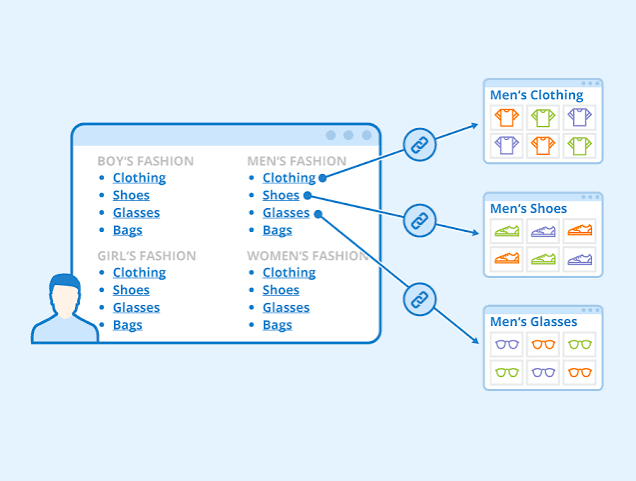
It wins on clarity for people. A well-organized HTML page can surface categories, subcategories, and key content in one place. That can reduce dead ends for users and give crawlers another route to reach pages that are otherwise buried.
This makes HTML sitemap useful for:
- small to mid-sized sites where visitors may want a full directory;
- legacy sites with uneven navigation;
- sites with orphaned content that needs another internal link path;
- editorial sites that want a visible “site map” page for readers.
The drawback is that it is not a special indexing file. Bing has to crawl it like any other page. If the page becomes huge, cluttered, or outdated, it stops helping and starts looking like a maintenance artifact. Bit of a paper map problem, really.
Pros
- It is easy for readers to scan, which means lost visitors can reach important sections without guessing the site structure.
- It creates another internal linking hub, which can help crawlers reach deep URLs that are poorly linked elsewhere.
- It is understandable without specialist tools, so editors can audit the site structure faster.
Cons
- It has no XML-only metadata, so it does not give Bing the structured URL cues that a true sitemap file provides.
- It can become bloated on large sites, which means the page turns into a wall of links rather than a usable guide.
- It can go stale after content moves, which means the directory may point people and crawlers toward outdated paths.
Buy this if your site is small, your navigation is messy, or you want a public directory page that helps visitors and gives Bing another crawl path.
Skip it if you run a very large site and the page would become a long, unwieldy list that nobody wants to maintain.
One honest weakness of each
XML sitemap’s weakness is that people often treat it like a ranking tool when it is really a discovery tool. Bing can find URLs faster, but that does not override relevance, internal linking, or quality signals. An XML file with 10,000 weak URLs is still 10,000 weak URLs.
HTML sitemap’s weakness is that it looks helpful even when it adds little indexing value. A reader can see the page and assume it matters as much as the XML version, but for Bing it is just another crawlable page with links. That difference is the whole decision.
Who should get the Bing XML sitemap?
Bing XML sitemap is for site owners who care about crawler discovery first and human navigation second, especially on sites with many URLs, frequent publishing, or weak internal linking [Bing Webmaster Guidelines].
If you manage an ecommerce catalog, a news archive, a documentation site, or any site where important URLs sit deep in the architecture, XML is the safer bet. It gives Bing the clearest inventory of what exists and what changed.
It is the wrong choice only if you expect it to replace real site structure. It cannot fix a poor architecture by itself, and it will not rescue noindex pages or duplicate URL variants.
Who should get the HTML sitemap?
HTML sitemap is for site owners who want a visible directory page for readers and a secondary crawl path for Bing, especially on small to mid-sized sites.
If your audience gets lost in your menus or your site has old sections that never earned strong internal links, HTML can help people orient themselves. It is also useful when you want a “site map” page that editors can check without XML tooling.
It is the wrong choice if you are hoping for the strongest possible indexing signal. For that, XML is the cleaner mechanism, and HTML should be treated as a support page rather than the main event.
How we compared
Since Bing XML sitemap and HTML sitemap solve different problems, we compared two sitemap formats against four practical questions: how Bing discovers URLs, how much structure each format gives crawlers, how much value each gives humans, and how well each scales as a site grows. We read Bing’s published guidance, the sitemaps protocol, and documentation that explains XML sitemap submission and crawl handling. No product count applies here; this comparison is about two formats, not a lineup.
FAQ
Does Bing need both XML and HTML sitemaps?
Yes, but XML should be the priority if indexing is the goal. HTML is a useful supplement when you also want a visible directory for users.
Will an HTML sitemap index pages faster than XML?
Usually no. HTML can help Bing discover pages through links, but XML is the more direct crawl-discovery format.
Can an XML sitemap replace internal linking?
No. Bing still relies on internal links, canonical tags, robots rules, and page quality. A sitemap supports those signals; it does not replace them.
Is a sitemap enough for indexing new pages?
Not by itself. It helps discovery, but Bing still has to crawl and accept the page for indexing.
Which is better for a small site?
HTML can be enough for a very small site, but if you want the stronger indexing tool, XML still wins.
Final verdict
Bing XML sitemap is the better indexing choice, and HTML sitemap is the better navigation aid.
If you can only pick one for search discovery, pick XML. The condition that flips the answer is simple: if your biggest problem is helping users and crawlers move through a small or messy site, HTML becomes the useful support file, but it still does not beat XML for indexing.
Drafted with AI; not yet reviewed by a person.